1
2
3
4
5
6
7
8
9
10
11
12
13
14
15
16
17
18
19
20
21
22
23
24
25
26
27
28
29
30
31
32
33
34
35
36
37
38
39
40
41
42
43
44
45
46
47
48
49
50
51
52
53
54
55
56
57
58
59
60
61
62
63
64
65
66
67
68
69
70
71
72
73
74
75
76
77
78
79
80
81
82
83
84
85
86
87
88
89
90
91
92
93
94
95
96
97
98
99
100
101
102
103
104
105
106
107
108
109
110
111
112
113
114
115
116
117
118
119
120
121
122
123
124
125
126
127
128
129
130
131
132
133
134
135
136
137
138
139
140
141
142
143
144
145
146
147
148
149
150
151
152
153
154
155
156
157
158
159
160
161
162
163
164
165
166
167
168
169
170
171
172
173
174
175
176
177
178
179
180
181
182
183
184
|
---
layout: docs
title: "Memories"
section: "chisel3"
---
# Memories
Chisel provides facilities for creating both read only and read/write memories.
## ROM
Users can define read-only memories by constructing a `Vec` with `VecInit`.
`VecInit` can accept either a variable-argument number of `Data` literals or a `Seq[Data]` literals that initialize the ROM.
For example, users can create a small ROM initialized to 1, 2, 4, 8 and loop through all values using a counter as an address generator as follows:
```scala mdoc:compile-only
import chisel3._
import chisel3.util.Counter
val m = VecInit(1.U, 2.U, 4.U, 8.U)
val c = Counter(m.length)
c.inc()
val r = m(c.value)
```
We can create an *n* value sine lookup table generator using a ROM initialized as follows:
```scala mdoc:compile-only
import chisel3._
val Pi = math.Pi
def sinTable(amp: Double, n: Int) = {
val times =
(0 until n).map(i => (i*2*Pi)/(n.toDouble-1) - Pi)
val inits =
times.map(t => Math.round(amp * math.sin(t)).asSInt(32.W))
VecInit(inits)
}
```
where `amp` is used to scale the fixpoint values stored in the ROM.
## Read-Write Memories
Memories are given special treatment in Chisel since hardware implementations of memory vary greatly. For example, FPGA memories are instantiated quite differently from ASIC memories. Chisel defines a memory abstraction that can map to either simple Verilog behavioural descriptions or to instances of memory modules that are available from external memory generators provided by foundry or IP vendors.
### `SyncReadMem`: sequential/synchronous-read, sequential/synchronous-write
Chisel has a construct called `SyncReadMem` for sequential/synchronous-read, sequential/synchronous-write memories. These `SyncReadMem`s will likely be synthesized to technology SRAMs (as opposed to register banks).
If the same memory address is both written and sequentially read on the same clock edge, or if a sequential read enable is cleared, then the read data is undefined.
Values on the read data port are not guaranteed to be held until the next read cycle. If that is the desired behavior, external logic to hold the last read value must be added.
#### Read port/write port
Ports into `SyncReadMem`s are created by applying a `UInt` index. A 1024-entry SRAM with one write port and one read port might be expressed as follows:
```scala mdoc:silent
import chisel3._
class ReadWriteSmem extends Module {
val width: Int = 32
val io = IO(new Bundle {
val enable = Input(Bool())
val write = Input(Bool())
val addr = Input(UInt(10.W))
val dataIn = Input(UInt(width.W))
val dataOut = Output(UInt(width.W))
})
val mem = SyncReadMem(1024, UInt(width.W))
// Create one write port and one read port
mem.write(io.addr, io.dataIn)
io.dataOut := mem.read(io.addr, io.enable)
}
```
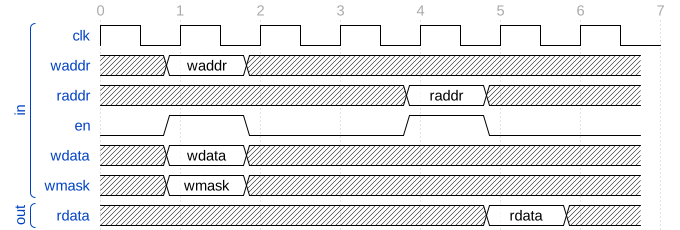
Below is an example waveform of the one write port/one read port `SyncReadMem` with [masks](#masks). Note that the signal names will differ from the exact wire names generated for the `SyncReadMem`. With masking, it is also possible that multiple RTL arrays will be generated with the behavior below.
#### Single-ported
Single-ported SRAMs can be inferred when the read and write conditions are mutually exclusive in the same `when` chain:
```scala mdoc:silent
import chisel3._
class RWSmem extends Module {
val width: Int = 32
val io = IO(new Bundle {
val enable = Input(Bool())
val write = Input(Bool())
val addr = Input(UInt(10.W))
val dataIn = Input(UInt(width.W))
val dataOut = Output(UInt(width.W))
})
val mem = SyncReadMem(1024, UInt(width.W))
io.dataOut := DontCare
when(io.enable) {
val rdwrPort = mem(io.addr)
when (io.write) { rdwrPort := io.dataIn }
.otherwise { io.dataOut := rdwrPort }
}
}
```
(The `DontCare` is there to make Chisel's [unconnected wire detection](unconnected-wires) aware that reading while writing is undefined.)
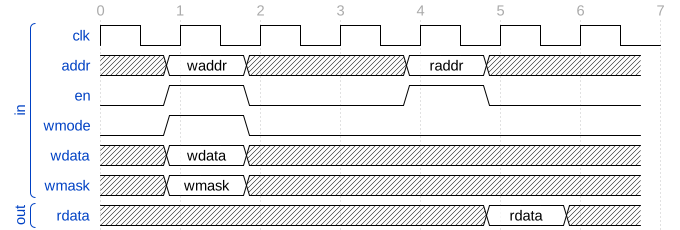
Here is an example single read/write port waveform, with [masks](#masks) (again, generated signal names and number of arrays may differ):
### `Mem`: combinational/asynchronous-read, sequential/synchronous-write
Chisel supports random-access memories via the `Mem` construct. Writes to `Mem`s are combinational/asynchronous-read, sequential/synchronous-write. These `Mem`s will likely be synthesized to register banks, since most SRAMs in modern technologies (FPGA, ASIC) tend to no longer support combinational (asynchronous) reads.
Creating asynchronous-read versions of the examples above simply involves replacing `SyncReadMem` with `Mem`.
### Masks
Chisel memories also support write masks for subword writes. Chisel will infer masks if the data type of the memory is a vector. To infer a mask, specify the `mask` argument of the `write` function which creates write ports. A given masked length is written if the corresponding mask bit is set. For example, in the example below, if the 0th bit of mask is true, it will write the lower byte of the data at corresponding address.
```scala mdoc:silent
import chisel3._
class MaskedReadWriteSmem extends Module {
val width: Int = 8
val io = IO(new Bundle {
val enable = Input(Bool())
val write = Input(Bool())
val addr = Input(UInt(10.W))
val mask = Input(Vec(4, Bool()))
val dataIn = Input(Vec(4, UInt(width.W)))
val dataOut = Output(Vec(4, UInt(width.W)))
})
// Create a 32-bit wide memory that is byte-masked
val mem = SyncReadMem(1024, Vec(4, UInt(width.W)))
// Write with mask
mem.write(io.addr, io.dataIn, io.mask)
io.dataOut := mem.read(io.addr, io.enable)
}
```
Here is an example of masks with readwrite ports:
```scala mdoc:silent
import chisel3._
class MaskedRWSmem extends Module {
val width: Int = 32
val io = IO(new Bundle {
val enable = Input(Bool())
val write = Input(Bool())
val mask = Input(Vec(2, Bool()))
val addr = Input(UInt(10.W))
val dataIn = Input(Vec(2, UInt(width.W)))
val dataOut = Output(Vec(2, UInt(width.W)))
})
val mem = SyncReadMem(1024, Vec(2, UInt(width.W)))
io.dataOut := DontCare
when(io.enable) {
val rdwrPort = mem(io.addr)
when (io.write) {
when(io.mask(0)) {
rdwrPort(0) := io.dataIn(0)
}
when(io.mask(1)) {
rdwrPort(1) := io.dataIn(1)
}
}.otherwise { io.dataOut := rdwrPort }
}
}
```
### Memory Initialization
Chisel memories can be initialized from an external `binary` or `hex` file emitting proper Verilog for synthesis or simulation. There are multiple modes of initialization.
For more information, check the experimental docs on [Loading Memories](../appendix/experimental-features#loading-memories) feature.
|
