1
2
3
4
5
6
7
8
9
10
11
12
13
14
15
16
17
18
19
20
21
22
23
24
25
26
27
28
29
30
31
32
33
34
35
36
37
38
39
40
41
42
43
44
45
46
47
48
49
50
51
52
53
54
55
56
57
58
59
60
61
62
63
64
65
66
67
68
69
70
71
72
73
74
75
76
77
78
79
80
81
82
83
84
85
86
87
88
89
90
91
92
93
94
95
96
97
98
99
100
101
102
103
104
105
106
107
108
109
110
111
112
113
114
115
116
117
118
119
120
121
122
123
124
125
126
127
128
129
130
131
132
133
134
135
136
137
138
139
140
141
142
143
144
145
146
147
148
149
150
151
152
153
154
155
156
157
158
159
160
161
162
163
164
165
166
167
168
169
170
171
172
173
174
175
176
177
178
179
180
181
182
183
184
185
186
187
188
189
190
191
192
193
194
195
196
197
198
199
200
201
202
203
204
205
206
207
208
209
210
211
212
213
214
215
216
217
218
219
220
221
222
223
224
225
226
227
228
229
230
231
232
233
234
235
236
237
238
239
240
241
242
243
244
245
246
247
248
249
250
251
252
253
254
255
256
257
258
259
260
261
262
263
264
265
266
267
268
269
270
271
272
273
274
275
276
277
278
279
280
281
282
283
284
285
286
287
288
289
290
291
292
293
294
295
296
297
298
299
300
301
302
303
304
305
306
307
308
309
310
311
312
313
314
315
316
317
318
319
320
321
322
323
324
325
326
327
328
329
330
331
332
333
334
335
336
337
338
339
340
341
342
343
344
345
346
347
348
349
350
351
352
353
354
355
356
357
358
359
360
361
362
363
364
365
366
367
368
369
370
371
372
373
374
|

---
The **Constructing Hardware in a Scala Embedded Language** ([**Chisel**](https://www.chisel-lang.org)) is an open-source hardware description language (HDL) used to describe digital electronics and circuits at the register-transfer level that facilitates **advanced circuit generation and design reuse for both ASIC and FPGA digital logic designs**.
Chisel adds hardware construction primitives to the [Scala](https://www.scala-lang.org) programming language, providing designers with the power of a modern programming language to write complex, parameterizable circuit generators that produce synthesizable Verilog.
This generator methodology enables the creation of re-usable components and libraries, such as the FIFO queue and arbiters in the [Chisel Standard Library](https://www.chisel-lang.org/api/latest/#chisel3.util.package), raising the level of abstraction in design while retaining fine-grained control.
For more information on the benefits of Chisel see: ["What benefits does Chisel offer over classic Hardware Description Languages?"](https://stackoverflow.com/questions/53007782/what-benefits-does-chisel-offer-over-classic-hardware-description-languages)
Chisel is powered by [FIRRTL (Flexible Intermediate Representation for RTL)](https://github.com/chipsalliance/firrtl), a hardware compiler framework that performs optimizations of Chisel-generated circuits and supports custom user-defined circuit transformations.
* [What does Chisel code look like?](#what-does-chisel-code-look-like)
* [LED blink](#led-blink)
* [FIR Filter](#fir-filter)
* [Getting Started](#getting-started)
* [Bootcamp Interactive Tutorial](#bootcamp-interactive-tutorial)
* [A Textbook on Chisel](#a-textbook-on-chisel)
* [Build Your Own Chisel Projects](#build-your-own-chisel-projects)
* [Guide For New Contributors](#guide-for-new-contributors)
* [Design Verification](#design-verification)
* [Documentation](#documentation)
* [Useful Resources](#useful-resources)
* [Chisel Dev Meeting](#chisel-dev-meeting)
* [Data Types Overview](#data-types-overview)
* [Contributor Documentation](#contributor-documentation)
* [Useful Resources for Contributors](#useful-resources-for-contributors)
* [Compiling and Testing Chisel](#compiling-and-testing-chisel)
* [Running Projects Against Local Chisel](#running-projects-against-local-chisel)
* [Building Chisel with FIRRTL in the same SBT Project](#building-chisel-with-firrtl-in-the-same-sbt-project)
* [Chisel3 Architecture Overview](#chisel3-architecture-overview)
* [Chisel Sub-Projects](#chisel-sub-projects)
* [Which version should I use?](#which-version-should-i-use)
---
[](https://gitter.im/freechipsproject/chisel3?utm_source=badge&utm_medium=badge&utm_campaign=pr-badge&utm_content=badge)

[](https://github.com/chipsalliance/chisel3/releases/latest)
[](https://index.scala-lang.org/chipsalliance/chisel3/chisel3)
[](https://oss.sonatype.org/content/repositories/snapshots/edu/berkeley/cs/)
[](https://javadoc.io/doc/edu.berkeley.cs/chisel3_2.13/latest)
## What does Chisel code look like?
### LED blink
```scala
import chisel3._
import chisel3.util._
class Blinky(freq: Int, startOn: Boolean = false) extends Module {
val io = IO(new Bundle {
val led0 = Output(Bool())
})
// Blink LED every second using Chisel built-in util.Counter
val led = RegInit(startOn.B)
val (_, counterWrap) = Counter(true.B, freq / 2)
when(counterWrap) {
led := ~led
}
io.led0 := led
}
object Main extends App {
// These lines generate the Verilog output
println(
new (chisel3.stage.ChiselStage).emitVerilog(
new Blinky(1000),
Array(
"--emission-options=disableMemRandomization,disableRegisterRandomization"
)
)
)
}
```
Should output the following Verilog:
<details>
<summary>Click to expand!</summary>
<pre class="hljs"><code><div><span class="hljs-keyword">module</span> Blinky(
<span class="hljs-keyword">input</span> clock,
<span class="hljs-keyword">input</span> reset,
<span class="hljs-keyword">output</span> io_led0
);
<span class="hljs-keyword">reg</span> led; <span class="hljs-comment">// @[main.scala 11:20]</span>
<span class="hljs-keyword">reg</span> [<span class="hljs-number">8</span>:<span class="hljs-number">0</span>] counterWrap_value; <span class="hljs-comment">// @[Counter.scala 62:40]</span>
<span class="hljs-keyword">wire</span> counterWrap_wrap_wrap = counterWrap_value == <span class="hljs-number">9'h1f3</span>; <span class="hljs-comment">// @[Counter.scala 74:24]</span>
<span class="hljs-keyword">wire</span> [<span class="hljs-number">8</span>:<span class="hljs-number">0</span>] <span class="hljs-number">_</span>counterWrap_wrap_value_T_1 = counterWrap_value + <span class="hljs-number">9'h1</span>; <span class="hljs-comment">// @[Counter.scala 78:24]</span>
<span class="hljs-keyword">assign</span> io_led0 = led; <span class="hljs-comment">// @[main.scala 16:11]</span>
<span class="hljs-keyword">always</span> @(<span class="hljs-keyword">posedge</span> clock) <span class="hljs-keyword">begin</span>
<span class="hljs-keyword">if</span> (reset) <span class="hljs-keyword">begin</span> <span class="hljs-comment">// @[main.scala 11:20]</span>
led <= <span class="hljs-number">1'h0</span>; <span class="hljs-comment">// @[main.scala 11:20]</span>
<span class="hljs-keyword">end</span> <span class="hljs-keyword">else</span> <span class="hljs-keyword">if</span> (counterWrap_wrap_wrap) <span class="hljs-keyword">begin</span> <span class="hljs-comment">// @[main.scala 13:21]</span>
led <= ~led; <span class="hljs-comment">// @[main.scala 14:9]</span>
<span class="hljs-keyword">end</span>
<span class="hljs-keyword">if</span> (reset) <span class="hljs-keyword">begin</span> <span class="hljs-comment">// @[Counter.scala 62:40]</span>
counterWrap_value <= <span class="hljs-number">9'h0</span>; <span class="hljs-comment">// @[Counter.scala 62:40]</span>
<span class="hljs-keyword">end</span> <span class="hljs-keyword">else</span> <span class="hljs-keyword">if</span> (counterWrap_wrap_wrap) <span class="hljs-keyword">begin</span> <span class="hljs-comment">// @[Counter.scala 88:20]</span>
counterWrap_value <= <span class="hljs-number">9'h0</span>; <span class="hljs-comment">// @[Counter.scala 88:28]</span>
<span class="hljs-keyword">end</span> <span class="hljs-keyword">else</span> <span class="hljs-keyword">begin</span>
counterWrap_value <= <span class="hljs-number">_</span>counterWrap_wrap_value_T_1; <span class="hljs-comment">// @[Counter.scala 78:15]</span>
<span class="hljs-keyword">end</span>
<span class="hljs-keyword">end</span>
<span class="hljs-keyword">endmodule</span>
</div></code></pre>
</details>
### FIR Filter
Consider an FIR filter that implements a convolution operation, as depicted in this block diagram:
<img src="https://raw.githubusercontent.com/chipsalliance/chisel3/master/docs/src/images/fir_filter.svg?sanitize=true" width="512" />
While Chisel provides similar base primitives as synthesizable Verilog, and *could* be used as such:
```scala
// 3-point moving sum implemented in the style of a FIR filter
class MovingSum3(bitWidth: Int) extends Module {
val io = IO(new Bundle {
val in = Input(UInt(bitWidth.W))
val out = Output(UInt(bitWidth.W))
})
val z1 = RegNext(io.in)
val z2 = RegNext(z1)
io.out := (io.in * 1.U) + (z1 * 1.U) + (z2 * 1.U)
}
```
the power of Chisel comes from the ability to create generators, such as an FIR filter that is defined by the list of coefficients:
```scala
// Generalized FIR filter parameterized by the convolution coefficients
class FirFilter(bitWidth: Int, coeffs: Seq[UInt]) extends Module {
val io = IO(new Bundle {
val in = Input(UInt(bitWidth.W))
val out = Output(UInt(bitWidth.W))
})
// Create the serial-in, parallel-out shift register
val zs = Reg(Vec(coeffs.length, UInt(bitWidth.W)))
zs(0) := io.in
for (i <- 1 until coeffs.length) {
zs(i) := zs(i-1)
}
// Do the multiplies
val products = VecInit.tabulate(coeffs.length)(i => zs(i) * coeffs(i))
// Sum up the products
io.out := products.reduce(_ + _)
}
```
and use and re-use them across designs:
```scala
val movingSum3Filter = Module(new FirFilter(8, Seq(1.U, 1.U, 1.U))) // same 3-point moving sum filter as before
val delayFilter = Module(new FirFilter(8, Seq(0.U, 1.U))) // 1-cycle delay as a FIR filter
val triangleFilter = Module(new FirFilter(8, Seq(1.U, 2.U, 3.U, 2.U, 1.U))) // 5-point FIR filter with a triangle impulse response
```
The above can be converted to Verilog using `ChiselStage`:
```scala
import chisel3.stage.{ChiselStage, ChiselGeneratorAnnotation}
(new chisel3.stage.ChiselStage).execute(
Array("-X", "verilog"),
Seq(ChiselGeneratorAnnotation(() => new FirFilter(8, Seq(1.U, 1.U, 1.U)))))
```
Alternatively, you may generate some Verilog directly for inspection:
```scala
val verilogString = chisel3.emitVerilog(new FirFilter(8, Seq(0.U, 1.U)))
println(verilogString)
```
## Getting Started
### Bootcamp Interactive Tutorial
The [**online Chisel Bootcamp**](https://mybinder.org/v2/gh/freechipsproject/chisel-bootcamp/master) is the recommended way to get started with and learn Chisel.
**No setup is required** (it runs in the browser), nor does it assume any prior knowledge of Scala.
The [**classic Chisel tutorial**](https://github.com/ucb-bar/chisel-tutorial) contains small exercises and runs on your computer.
### A Textbook on Chisel
If you like a textbook to learn Chisel and also a bit of digital design in general, you may be interested in reading [**Digital Design with Chisel**](http://www.imm.dtu.dk/~masca/chisel-book.html). It is available in English, Chinese, Japanese, and Vietnamese.
### Build Your Own Chisel Projects
See [the setup instructions](SETUP.md) for how to set up your environment to build Chisel locally.
When you're ready to build your own circuits in Chisel, **we recommend starting from the [Chisel Template](https://github.com/freechipsproject/chisel-template) repository**, which provides a pre-configured project, example design, and testbench.
Follow the [chisel-template README](https://github.com/freechipsproject/chisel-template) to get started.
If you insist on setting up your own project from scratch, your project needs to depend on both the chisel3-plugin (Scalac plugin) and the chisel3 library.
For example, in SBT this could be expressed as:
```scala
// build.sbt
scalaVersion := "2.13.8"
addCompilerPlugin("edu.berkeley.cs" % "chisel3-plugin" % "3.5.3" cross CrossVersion.full)
libraryDependencies += "edu.berkeley.cs" %% "chisel3" % "3.5.3"
// We also recommend using chiseltest for writing unit tests
libraryDependencies += "edu.berkeley.cs" %% "chiseltest" % "0.5.3" % "test"
```
### Guide For New Contributors
If you are trying to make a contribution to this project, please read [CONTRIBUTING.md](https://github.com/chipsalliance/chisel3/blob/master/CONTRIBUTING.md)
### Design Verification
These simulation-based verification tools are available for Chisel:
* [**chiseltest**](https://github.com/ucb-bar/chiseltest) is the batteries-included testing and formal verification library for Chisel-based RTL designs and a replacement for the former PeekPokeTester, providing the same base constructs but with a streamlined interface and concurrency support with `fork` and `join` with internal and Verilator integration for simulations.
## Documentation
### Useful Resources
* [**Cheat Sheet**](https://github.com/freechipsproject/chisel-cheatsheet/releases/latest/download/chisel_cheatsheet.pdf), a 2-page reference of the base Chisel syntax and libraries
* [**ScalaDoc**](https://www.chisel-lang.org/api/latest/chisel3/index.html), a listing, description, and examples of the functionality exposed by Chisel
* [**Gitter**](https://gitter.im/freechipsproject/chisel3), where you can ask questions or discuss anything Chisel
* [**Website**](https://www.chisel-lang.org) ([source](https://github.com/freechipsproject/www.chisel-lang.org/))
* [**Scastie (3.5.3)**](https://scastie.scala-lang.org/O3LqeVH7SWyIxD7bZRH8hA)
* [**asic-world**](http://www.asic-world.com/verilog/veritut.html) If you aren't familiar with verilog, this is a good tutorial.
If you are migrating from Chisel2, see [the migration guide](https://www.chisel-lang.org/chisel3/chisel3-vs-chisel2.html).
### Chisel Dev Meeting
Chisel/FIRRTL development meetings happen every Monday from 1100--1200 PT.
Call-in info and meeting notes are available [here](https://docs.google.com/document/d/1BLP2DYt59DqI-FgFCcjw8Ddl4K-WU0nHmQu0sZ_wAGo/).
### Data Types Overview
These are the base data types for defining circuit components:
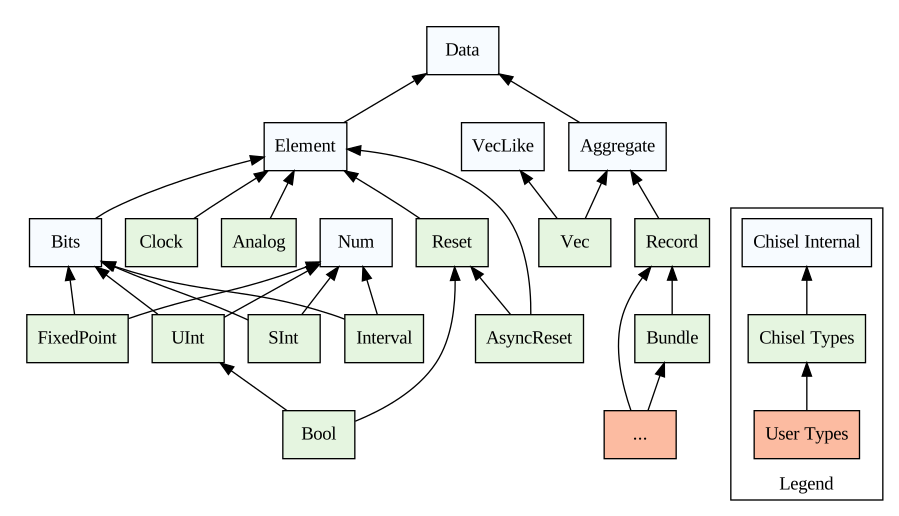
## Contributor Documentation
This section describes how to get started contributing to Chisel itself, including how to test your version locally against other projects that pull in Chisel using [sbt's managed dependencies](https://www.scala-sbt.org/1.x/docs/Library-Dependencies.html).
### Useful Resources for Contributors
The [Useful Resources](#useful-resources) for users are also helpful for contributors.
* [**Chisel Breakdown Slides**](https://docs.google.com/presentation/d/114YihixFBPCfUnv1inqAL8UjsiWfcNWdPHX7SeqlRQc), an introductory talk about Chisel's internals
### Compiling and Testing Chisel
You must first install required dependencies to build Chisel locally, please see [the setup instructions](SETUP.md).
Clone and build the Chisel library:
```bash
git clone https://github.com/chipsalliance/chisel3.git
cd chisel3
sbt compile
```
In order to run the following unit tests, you will need several tools on your `PATH`, namely
[verilator](https://www.veripool.org/verilator/),
[yosys](http://www.clifford.at/yosys/),
[espresso](https://github.com/chipsalliance/espresso),
and [z3](https://github.com/Z3Prover/z3).
Check that each is installed on your `PATH` by running `which verilator` and so on.
If the compilation succeeded and the dependencies noted above are installed, you can then run the included unit tests by invoking:
```bash
sbt test
```
### Running Projects Against Local Chisel
To use the development version of Chisel (`master` branch), you will need to build from source and `publishLocal`.
The repository version can be found in the [build.sbt](build.sbt) file.
As of the time of writing it was:
```scala
version := "3.5-SNAPSHOT"
```
To publish your version of Chisel to the local Ivy (sbt's dependency manager) repository, run:
```bash
sbt publishLocal
```
The compiled version gets placed in `~/.ivy2/local/edu.berkeley.cs/`.
If you need to un-publish your local copy of Chisel, remove the directory generated in `~/.ivy2/local/edu.berkeley.cs/`.
In order to have your projects use this version of Chisel, you should update the `libraryDependencies` setting in your project's build.sbt file to:
```scala
libraryDependencies += "edu.berkeley.cs" %% "chisel3" % "3.5-SNAPSHOT"
```
### Building Chisel with FIRRTL in the same SBT Project
While we recommend using the library dependency approach as described above, it is possible to build Chisel and FIRRTL in a single SBT project.
**Caveats**:
* This only works for the "main" configuration; you cannot build the Chisel tests this way because `treadle` is only supported as a library dependency.
* Do not `publishLocal` when building this way. The published artifact will be missing the FIRRTL dependency.
This works by using [sbt-sriracha](http://eed3si9n.com/hot-source-dependencies-using-sbt-sriracha), an SBT plugin for toggling between source and library dependencies.
It provides two JVM system properties that, when set, will tell SBT to include FIRRTL as a source project:
* `sbt.sourcemode` - when set to true, SBT will look for FIRRTL in the workspace
* `sbt.workspace` - sets the root directory of the workspace
Example use:
```bash
# From root of this repo
git clone git@github.com:chipsalliance/firrtl.git
sbt -Dsbt.sourcemode=true -Dsbt.workspace=$PWD
```
This is primarily useful for building projects that themselves want to include Chisel as a source dependency.
As an example, see [Rocket Chip](https://github.com/chipsalliance/rocket-chip)
### Chisel3 Architecture Overview
The Chisel3 compiler consists of these main parts:
* **The frontend**, `chisel3.*`, which is the publicly visible "API" of Chisel and what is used in Chisel RTL. These just add data to the...
* **The Builder**, `chisel3.internal.Builder`, which maintains global state (like the currently open Module) and contains commands, generating...
* **The intermediate data structures**, `chisel3.firrtl.*`, which are syntactically very similar to Firrtl. Once the entire circuit has been elaborated, the top-level object (a `Circuit`) is then passed to...
* **The Firrtl emitter**, `chisel3.firrtl.Emitter`, which turns the intermediate data structures into a string that can be written out into a Firrtl file for further processing.
Also included is:
* **The standard library** of circuit generators, `chisel3.util.*`. These contain commonly used interfaces and constructors (like `Decoupled`, which wraps a signal with a ready-valid pair) as well as fully parameterizable circuit generators (like arbiters and multiplexors).
* **Chisel Stage**, `chisel3.stage.*`, which contains compilation and test functions that are invoked in the standard Verilog generation and simulation testing infrastructure. These can also be used as part of custom flows.
### Chisel Sub-Projects
Chisel consists of 4 Scala projects; each is its own separate compilation unit:
* [`core`](core) is the bulk of the source code of Chisel, depends on `macros`
* [`src/main`](src/main) is the "main" that brings it all together and includes a [`util`](src/main/scala/chisel3/util) library, which depends on `core`
* [`plugin`](plugin) is the compiler plugin, no internal dependencies
* [`macros`](macros) is most of the macros used in Chisel, no internal dependencies
Code that touches lots of APIs that are private to the `chisel3` package should belong in `core`, while code that is pure Chisel should belong in `src/main`.
### Which version should I use?
We encourage Chisel users (as opposed to Chisel developers), to use the latest release version of Chisel.
This [chisel-template](https://github.com/freechipsproject/chisel-template) repository is kept up-to-date, depending on the most recent version of Chisel.
The recommended version is also captured near the top of this README, and in the [Github releases](https://github.com/chipsalliance/chisel3/releases) section of this repo.
If you encounter an issue with a released version of Chisel, please file an issue on GitHub mentioning the Chisel version and provide a simple test case (if possible).
Try to reproduce the issue with the associated latest minor release (to verify that the issue hasn't been addressed).
For more information on our versioning policy and what versions of the various Chisel ecosystem projects work together, see [Chisel Project Versioning](https://www.chisel-lang.org/chisel3/docs/appendix/versioning.html).
If you're developing a Chisel library (or `chisel3` itself), you'll probably want to work closer to the tip of the development trunk.
By default, the master branches of the chisel repositories are configured to build and publish their version of the code as `Z.Y-SNAPSHOT`.
Updated SNAPSHOTs are publised on every push to master.
You are encouraged to do your development against the latest SNAPSHOT, but note that neither API nor ABI compatibility is guaranteed so your code may break at any time.
|
