
diff options
| -rw-r--r-- | README.md | 200 |
1 files changed, 144 insertions, 56 deletions
@@ -2,34 +2,114 @@ --- -## Upcoming Events +The **Constructing Hardware in a Scala Embedded Language** ([**Chisel**](https://www.chisel-lang.org)) is an open-source hardware description language (HDL) used to describe digital electronics and circuits at the register-transfer level that facilitates **advanced circuit generation and design reuse for both ASIC and FPGA digital logic designs**. -### Chisel Dev Meeting -Chisel/FIRRTL development meetings happen every Monday and Tuesday from 1100--1200 PT. +Chisel adds hardware construction primitives to the [Scala](https://www.scala-lang.org) programming language, providing designers with the power of a modern programming language to write complex, parameterizable circuit generators that produce synthesizable Verilog. +This generator methodology enables the creation of re-usable components and libraries, such as the FIFO queue and arbiters in the [Chisel Standard Library](https://www.chisel-lang.org/api/latest/#chisel3.util.package), raising the level of abstraction in design while retaining fine-grained control. -Call-in info and meeting notes are available [here](https://docs.google.com/document/d/1BLP2DYt59DqI-FgFCcjw8Ddl4K-WU0nHmQu0sZ_wAGo/). +For more information on the benefits of Chisel see: ["What benefits does Chisel offer over classic Hardware Description Languages?"](https://stackoverflow.com/questions/53007782/what-benefits-does-chisel-offer-over-classic-hardware-description-languages) + +Chisel is powered by [FIRRTL (Flexible Intermediate Representation for RTL)](https://github.com/chipsalliance/firrtl), a hardware compiler framework that performs optimizations of Chisel-generated circuits and supports custom user-defined circuit transformations. -### Chisel Community Conference 2021, Shanghai, China. -CCC is an annual gathering of Chisel community enthusiasts and technical exchange workshop. -This year with the support of the Chisel development community and RISC-V World Conference China 2021 Committee, we have brought together designers and developers with hands-on experience in Chisel from home and abroad to share cutting-edge results and experiences from both the open source community as well as industry. -English translated recordings version will be updated soon. -Looking forward to CCC 2022! See you then! +* [What does Chisel code look like?](#what-does-chisel-code-look-like) + * [LED blink](#led-blink) + * [FIR Filter](#fir-filter) +* [Getting Started](#getting-started) + * [Bootcamp Interactive Tutorial](#bootcamp-interactive-tutorial) + * [A Textbook on Chisel](#a-textbook-on-chisel) + * [Build Your Own Chisel Projects](#build-your-own-chisel-projects) + * [Guide For New Contributors](#guide-for-new-contributors) + * [Design Verification](#design-verification) +* [Documentation](#documentation) + * [Useful Resources](#useful-resources) + * [Chisel Dev Meeting](#chisel-dev-meeting) + * [Data Types Overview](#data-types-overview) +* [Contributor Documentation](#contributor-documentation) + * [Useful Resources for Contributors](#useful-resources-for-contributors) + * [Compiling and Testing Chisel](#compiling-and-testing-chisel) + * [Running Projects Against Local Chisel](#running-projects-against-local-chisel) + * [Building Chisel with FIRRTL in the same SBT Project](#building-chisel-with-firrtl-in-the-same-sbt-project) + * [Chisel3 Architecture Overview](#chisel3-architecture-overview) + * [Chisel Sub-Projects](#chisel-sub-projects) + * [Which version should I use?](#which-version-should-i-use) --- [](https://gitter.im/freechipsproject/chisel3?utm_source=badge&utm_medium=badge&utm_campaign=pr-badge&utm_content=badge)  [](https://github.com/chipsalliance/chisel3/releases/latest) +[](https://index.scala-lang.org/chipsalliance/chisel3/chisel3) +[](https://oss.sonatype.org/content/repositories/snapshots/edu/berkeley/cs/) +[](https://javadoc.io/doc/edu.berkeley.cs/chisel3_2.13/latest) -[**Chisel**](https://www.chisel-lang.org) is a hardware design language that facilitates **advanced circuit generation and design reuse for both ASIC and FPGA digital logic designs**. -Chisel adds hardware construction primitives to the [Scala](https://www.scala-lang.org) programming language, providing designers with the power of a modern programming language to write complex, parameterizable circuit generators that produce synthesizable Verilog. -This generator methodology enables the creation of re-usable components and libraries, such as the FIFO queue and arbiters in the [Chisel Standard Library](https://www.chisel-lang.org/api/latest/#chisel3.util.package), raising the level of abstraction in design while retaining fine-grained control. +## What does Chisel code look like? -For more information on the benefits of Chisel see: ["What benefits does Chisel offer over classic Hardware Description Languages?"](https://stackoverflow.com/questions/53007782/what-benefits-does-chisel-offer-over-classic-hardware-description-languages) +### LED blink -Chisel is powered by [FIRRTL (Flexible Intermediate Representation for RTL)](https://github.com/chipsalliance/firrtl), a hardware compiler framework that performs optimizations of Chisel-generated circuits and supports custom user-defined circuit transformations. +```scala +import chisel3._ +import chisel3.util._ -## What does Chisel code look like? +class Blinky(freq: Int, startOn: Boolean = false) extends Module { + val io = IO(new Bundle { + val led0 = Output(Bool()) + }) + // Blink LED every second using Chisel built-in util.Counter + val led = RegInit(startOn.B) + val (_, counterWrap) = Counter(true.B, freq / 2) + when(counterWrap) { + led := ~led + } + io.led0 := led +} +object Main extends App { + // These lines generate the Verilog output + println( + new (chisel3.stage.ChiselStage).emitVerilog( + new Blinky(1000), + Array( + "--emission-options=disableMemRandomization,disableRegisterRandomization" + ) + ) + ) +} +``` + +Should output the following Verilog: +<details> +<summary>Click to expand!</summary> + +```verilog +module Blinky( + input clock, + input reset, + output io_led0 +); + reg led; // @[main.scala 11:20] + reg [8:0] counterWrap_value; // @[Counter.scala 62:40] + wire counterWrap_wrap_wrap = counterWrap_value == 9'h1f3; // @[Counter.scala 74:24] + wire [8:0] _counterWrap_wrap_value_T_1 = counterWrap_value + 9'h1; // @[Counter.scala 78:24] + assign io_led0 = led; // @[main.scala 16:11] + always @(posedge clock) begin + if (reset) begin // @[main.scala 11:20] + led <= 1'h0; // @[main.scala 11:20] + end else if (counterWrap_wrap_wrap) begin // @[main.scala 13:21] + led <= ~led; // @[main.scala 14:9] + end + if (reset) begin // @[Counter.scala 62:40] + counterWrap_value <= 9'h0; // @[Counter.scala 62:40] + end else if (counterWrap_wrap_wrap) begin // @[Counter.scala 88:20] + counterWrap_value <= 9'h0; // @[Counter.scala 88:28] + end else begin + counterWrap_value <= _counterWrap_wrap_value_T_1; // @[Counter.scala 78:15] + end + end +endmodule +``` + +</details> + +### FIR Filter Consider an FIR filter that implements a convolution operation, as depicted in this block diagram: @@ -53,6 +133,7 @@ class MovingSum3(bitWidth: Int) extends Module { ``` the power of Chisel comes from the ability to create generators, such as an FIR filter that is defined by the list of coefficients: + ```scala // Generalized FIR filter parameterized by the convolution coefficients class FirFilter(bitWidth: Int, coeffs: Seq[UInt]) extends Module { @@ -76,6 +157,7 @@ class FirFilter(bitWidth: Int, coeffs: Seq[UInt]) extends Module { ``` and use and re-use them across designs: + ```scala val movingSum3Filter = Module(new FirFilter(8, Seq(1.U, 1.U, 1.U))) // same 3-point moving sum filter as before val delayFilter = Module(new FirFilter(8, Seq(0.U, 1.U))) // 1-cycle delay as a FIR filter @@ -83,6 +165,7 @@ val triangleFilter = Module(new FirFilter(8, Seq(1.U, 2.U, 3.U, 2.U, 1.U))) // ``` The above can be converted to Verilog using `ChiselStage`: + ```scala import chisel3.stage.{ChiselStage, ChiselGeneratorAnnotation} @@ -92,6 +175,7 @@ import chisel3.stage.{ChiselStage, ChiselGeneratorAnnotation} ``` Alternatively, you may generate some Verilog directly for inspection: + ```scala val verilogString = chisel3.emitVerilog(new FirFilter(8, Seq(0.U, 1.U))) println(verilogString) @@ -100,6 +184,7 @@ println(verilogString) ## Getting Started ### Bootcamp Interactive Tutorial + The [**online Chisel Bootcamp**](https://mybinder.org/v2/gh/freechipsproject/chisel-bootcamp/master) is the recommended way to get started with and learn Chisel. **No setup is required** (it runs in the browser), nor does it assume any prior knowledge of Scala. @@ -118,50 +203,60 @@ Follow the [chisel-template README](https://github.com/freechipsproject/chisel-t If you insist on setting up your own project from scratch, your project needs to depend on both the chisel3-plugin (Scalac plugin) and the chisel3 library. For example, in SBT this could be expressed as: + ```scala // build.sbt -scalaVersion := "2.13.7" -addCompilerPlugin("edu.berkeley.cs" % "chisel3-plugin" % "3.5.0" cross CrossVersion.full) -libraryDependencies += "edu.berkeley.cs" %% "chisel3" % "3.5.0" -// We also recommend using chiseltest for writing unit tests -libraryDependencies += "edu.berkeley.cs" %% "chiseltest" % "0.5.0" % "test" +scalaVersion := "2.13.8" +addCompilerPlugin("edu.berkeley.cs" % "chisel3-plugin" % "3.5.3" cross CrossVersion.full) +libraryDependencies += "edu.berkeley.cs" %% "chisel3" % "3.5.3" +// We also recommend using chiseltest for writing unit tests +libraryDependencies += "edu.berkeley.cs" %% "chiseltest" % "0.5.3" % "test" ``` + ### Guide For New Contributors + If you are trying to make a contribution to this project, please read [CONTRIBUTING.md](https://github.com/Burnleydev1/chisel3/blob/recent_PR/CONTRIBUTING.md) ### Design Verification These simulation-based verification tools are available for Chisel: -- [**iotesters**](https://github.com/freechipsproject/chisel-testers), specifically [PeekPokeTester](https://github.com/freechipsproject/chisel-testers/wiki/Using%20the%20PeekPokeTester), provides constructs (`peek`, `poke`, `expect`) similar to a non-synthesizable Verilog testbench. -- [**testers2**](https://github.com/ucb-bar/chisel-testers2) is an in-development replacement for PeekPokeTester, providing the same base constructs but with a streamlined interface and concurrency support with `fork` and `join`. +* [**chiseltest**](https://github.com/ucb-bar/chiseltest) is the batteries-included testing and formal verification library for Chisel-based RTL designs and a replacement for the former PeekPokeTester, providing the same base constructs but with a streamlined interface and concurrency support with `fork` and `join` with internal and Verilator integration for simulations. ## Documentation ### Useful Resources -- [**Cheat Sheet**](https://github.com/freechipsproject/chisel-cheatsheet/releases/latest/download/chisel_cheatsheet.pdf), a 2-page reference of the base Chisel syntax and libraries -- [**ScalaDoc**](https://www.chisel-lang.org/api/latest/chisel3/index.html), a listing, description, and examples of the functionality exposed by Chisel -- [**Gitter**](https://gitter.im/freechipsproject/chisel3), where you can ask questions or discuss anything Chisel -- [**Website**](https://www.chisel-lang.org) ([source](https://github.com/freechipsproject/www.chisel-lang.org/)) -- [**Scastie (3.5.0)**](https://scastie.scala-lang.org/9ga9i2DvQymKlA5JjS1ieA) -- [**asic-world**](http://www.asic-world.com/verilog/veritut.html) If you aren't familiar with verilog, this is a good tutorial. +* [**Cheat Sheet**](https://github.com/freechipsproject/chisel-cheatsheet/releases/latest/download/chisel_cheatsheet.pdf), a 2-page reference of the base Chisel syntax and libraries +* [**ScalaDoc**](https://www.chisel-lang.org/api/latest/chisel3/index.html), a listing, description, and examples of the functionality exposed by Chisel +* [**Gitter**](https://gitter.im/freechipsproject/chisel3), where you can ask questions or discuss anything Chisel +* [**Website**](https://www.chisel-lang.org) ([source](https://github.com/freechipsproject/www.chisel-lang.org/)) +* [**Scastie (3.5.3)**](https://scastie.scala-lang.org/O3LqeVH7SWyIxD7bZRH8hA) +* [**asic-world**](http://www.asic-world.com/verilog/veritut.html) If you aren't familiar with verilog, this is a good tutorial. If you are migrating from Chisel2, see [the migration guide](https://www.chisel-lang.org/chisel3/chisel3-vs-chisel2.html). +### Chisel Dev Meeting + +Chisel/FIRRTL development meetings happen every Monday and Tuesday from 1100--1200 PT. + +Call-in info and meeting notes are available [here](https://docs.google.com/document/d/1BLP2DYt59DqI-FgFCcjw8Ddl4K-WU0nHmQu0sZ_wAGo/). + ### Data Types Overview + These are the base data types for defining circuit components: 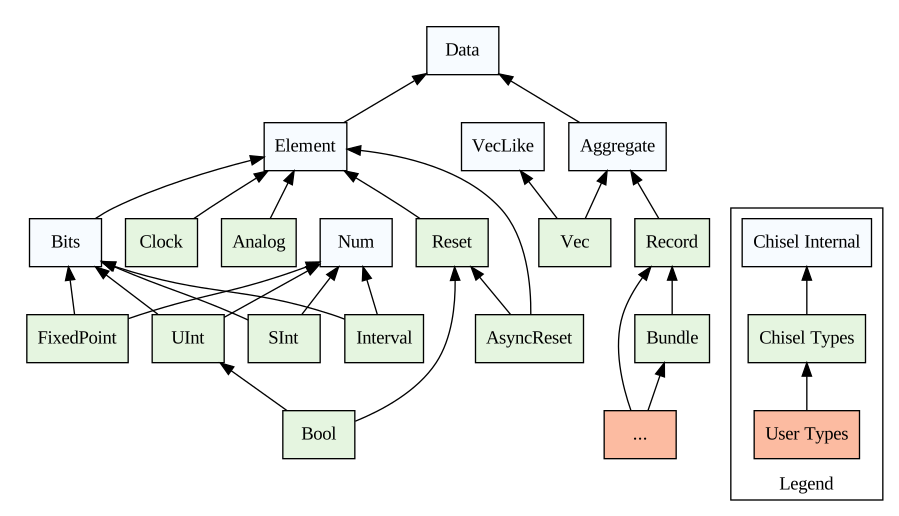 ## Contributor Documentation + This section describes how to get started contributing to Chisel itself, including how to test your version locally against other projects that pull in Chisel using [sbt's managed dependencies](https://www.scala-sbt.org/1.x/docs/Library-Dependencies.html). ### Useful Resources for Contributors The [Useful Resources](#useful-resources) for users are also helpful for contributors. -- [**Chisel Breakdown Slides**](https://docs.google.com/presentation/d/114YihixFBPCfUnv1inqAL8UjsiWfcNWdPHX7SeqlRQc), an introductory talk about Chisel's internals +* [**Chisel Breakdown Slides**](https://docs.google.com/presentation/d/114YihixFBPCfUnv1inqAL8UjsiWfcNWdPHX7SeqlRQc), an introductory talk about Chisel's internals ### Compiling and Testing Chisel @@ -184,7 +279,7 @@ Check that each is installed on your `PATH` by running `which verilator` and so If the compilation succeeded and the dependencies noted above are installed, you can then run the included unit tests by invoking: -``` +```bash sbt test ``` @@ -194,13 +289,13 @@ To use the development version of Chisel (`master` branch), you will need to bui The repository version can be found in the [build.sbt](build.sbt) file. As of the time of writing it was: -``` +```scala version := "3.5-SNAPSHOT" ``` To publish your version of Chisel to the local Ivy (sbt's dependency manager) repository, run: -``` +```bash sbt publishLocal ``` @@ -209,7 +304,7 @@ If you need to un-publish your local copy of Chisel, remove the directory genera In order to have your projects use this version of Chisel, you should update the `libraryDependencies` setting in your project's build.sbt file to: -``` +```scala libraryDependencies += "edu.berkeley.cs" %% "chisel3" % "3.5-SNAPSHOT" ``` @@ -217,16 +312,19 @@ libraryDependencies += "edu.berkeley.cs" %% "chisel3" % "3.5-SNAPSHOT" While we recommend using the library dependency approach as described above, it is possible to build Chisel and FIRRTL in a single SBT project. -**Caveats** +**Caveats**: + * This only works for the "main" configuration; you cannot build the Chisel tests this way because `treadle` is only supported as a library dependency. * Do not `publishLocal` when building this way. The published artifact will be missing the FIRRTL dependency. This works by using [sbt-sriracha](http://eed3si9n.com/hot-source-dependencies-using-sbt-sriracha), an SBT plugin for toggling between source and library dependencies. It provides two JVM system properties that, when set, will tell SBT to include FIRRTL as a source project: + * `sbt.sourcemode` - when set to true, SBT will look for FIRRTL in the workspace * `sbt.workspace` - sets the root directory of the workspace Example use: + ```bash # From root of this repo git clone git@github.com:chipsalliance/firrtl.git @@ -240,34 +338,24 @@ As an example, see [Rocket Chip](https://github.com/chipsalliance/rocket-chip) The Chisel3 compiler consists of these main parts: -- **The frontend**, `chisel3.*`, which is the publicly visible "API" of Chisel - and what is used in Chisel RTL. These just add data to the... -- **The Builder**, `chisel3.internal.Builder`, which maintains global state - (like the currently open Module) and contains commands, generating... -- **The intermediate data structures**, `chisel3.firrtl.*`, which are - syntactically very similar to Firrtl. Once the entire circuit has been - elaborated, the top-level object (a `Circuit`) is then passed to... -- **The Firrtl emitter**, `chisel3.firrtl.Emitter`, which turns the - intermediate data structures into a string that can be written out into a - Firrtl file for further processing. +* **The frontend**, `chisel3.*`, which is the publicly visible "API" of Chisel and what is used in Chisel RTL. These just add data to the... +* **The Builder**, `chisel3.internal.Builder`, which maintains global state (like the currently open Module) and contains commands, generating... +* **The intermediate data structures**, `chisel3.firrtl.*`, which are syntactically very similar to Firrtl. Once the entire circuit has been elaborated, the top-level object (a `Circuit`) is then passed to... +* **The Firrtl emitter**, `chisel3.firrtl.Emitter`, which turns the intermediate data structures into a string that can be written out into a Firrtl file for further processing. Also included is: -- **The standard library** of circuit generators, `chisel3.util.*`. These - contain commonly used interfaces and constructors (like `Decoupled`, which - wraps a signal with a ready-valid pair) as well as fully parameterizable - circuit generators (like arbiters and multiplexors). -- **Chisel Stage**, `chisel3.stage.*`, which contains compilation and test - functions that are invoked in the standard Verilog generation and simulation - testing infrastructure. These can also be used as part of custom flows. - + +* **The standard library** of circuit generators, `chisel3.util.*`. These contain commonly used interfaces and constructors (like `Decoupled`, which wraps a signal with a ready-valid pair) as well as fully parameterizable circuit generators (like arbiters and multiplexors). +* **Chisel Stage**, `chisel3.stage.*`, which contains compilation and test functions that are invoked in the standard Verilog generation and simulation testing infrastructure. These can also be used as part of custom flows. + ### Chisel Sub-Projects Chisel consists of 4 Scala projects; each is its own separate compilation unit: -- [`core`](core) is the bulk of the source code of Chisel, depends on `macros` -- [`src/main`](src/main) is the "main" that brings it all together and includes a [`util`](src/main/scala/chisel3/util) library, which depends on `core` -- [`plugin`](plugin) is the compiler plugin, no internal dependencies -- [`macros`](macros) is most of the macros used in Chisel, no internal dependencies +* [`core`](core) is the bulk of the source code of Chisel, depends on `macros` +* [`src/main`](src/main) is the "main" that brings it all together and includes a [`util`](src/main/scala/chisel3/util) library, which depends on `core` +* [`plugin`](plugin) is the compiler plugin, no internal dependencies +* [`macros`](macros) is most of the macros used in Chisel, no internal dependencies Code that touches lots of APIs that are private to the `chisel3` package should belong in `core`, while code that is pure Chisel should belong in `src/main`. |